
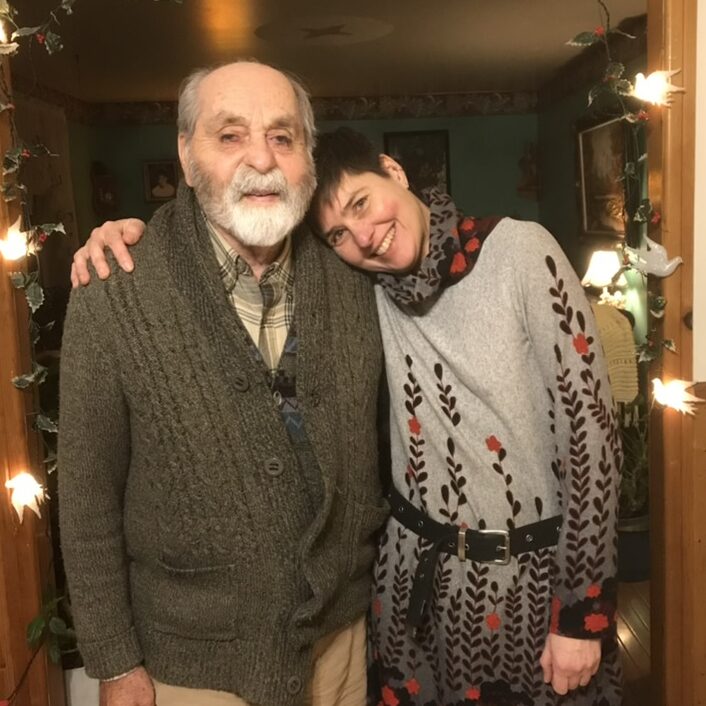
Mon papa qui sait tout
Did you know that my dad was a Baptist minister in Québec? He even built his own church in Rivière-du-Loup. He died on Feb. 25th at 85 years old. For many years his mind had been simplifying from Alzheimer’s disease. It is a disease of many losses but it is not without paradoxical gifts. My relationship with my dad simplified alongside his mind. Clown training allowed me to relate to him with a physical and emotional presence that gave us both many moments of joy and laughter and healing. I never thought we would dance together like we did so many times to ease the anxiety of sundowning. Joyful one minute and grumpy the very next. I learned to surf the moments with him.
At the point in the disease when he could still talk a little, I told him I was thinking of building a church. I described a place where every week a different way of worshipping would be practiced. I asked if this would be a good idea. He laughed and said “oh non non non!” and we laughed and laughed and laughed. In that shared moment, I could feel his unwavering confidence in me still. Of course it was a bad idea and of course I should do it.
He forgot he was a baptist minister. He thought he had been a carpenter, a builder. As we walked the neighbourhood together, he would point to random houses and say “J’ai fais ça” (I made that). Even so, the ministering did not stop. As he lost his words and the stories of helping others became pantomimes punctuated by emotional outbursts of “ben non!” (of course not!) and “et je lui ai dit!” (and I told him!), he kept replaying tales of justice and redemption. Near the end, he would bless people and objects with the catholic sign of the cross as a sign of appreciation. “Merci” became a solemn gift bestowed on others and one of the last words he could still say.
I recognise the double-edged idealism I inherited from him when I suddenly launch into a righteous sermon he would be proud of. I also recognise the delight in simple things like the defiant yellowness of a flower growing in the crack of a sidewalk. I used to be embarrassed by his awe at simple things. Now I’m embarrassed I was embarrassed.
I will miss him. His smile. His laughter. The funny faces we made at each other when words were no longer possible. The dances we would make up with dramatic finishes. His wordless wise counsel. I used to repeat a phrase to him that he would say to me when I was young: “tu es mon papa qui sait tout, surtout quand tu dors” (you’re my daddy that knows everything, especially when you’re sleeping). It would almost always bring a smile to his face. It could snap him out of a sad or grumpy moment. As I watched his body now so completely still, that phrase came to mind. But the last part no longer fit. He is just my daddy who truly knows everything now.